
Group day visit
A Day at Save Farm
Bring your school, college, corporate team or community group to our working farm in Dahanu. Explore, learn and spend time together — we’ll plan an outing around your group.
Minimum group size: 25 guests

School outings with room to discover.
Let students see how a working orchard grows, ask questions and try a hands-on activity. Tell us their age group and learning goals, and we will help shape the visit.
Group day visits · Minimum group size: 25 guests
Save Farm is a 25-acre working chikoo and mango orchard and a government-registered nursery in Gholvad, Dahanu. The farm has hosted student study tours in Botany, Rural Development and Environmental Studies for many years, from one-day visits to overnight study camps. Group day visits start at 25 guests, the farm can host more than 100 for a day, and each visit is planned around the students' age and subjects.
Students can see how fruit trees are propagated in one of the oldest private nurseries of the then Thane region, and how chikoo and mango are grown.
The vermi-compost unit, rainwater harvesting and the farm lake, bees kept for pollination and fish raised in canals between the chikoo rows.
A collection of more than 400 plant species alongside the orchard crops of chikoo, mango, coconut and litchi.
Rural activities such as Warli painting, the pottery wheel, mat weaving, basket weaving and bamboo craft, chosen with you for the group's age and time.
Save Farm is a six-page case study in Manan Prakashan's Environmental Studies II (F.Y.B.Com) and features in a 2018 OIIRJ paper on water for agritourism in the Konkan.
Alcohol and loud music are not allowed on the farm. The food is simple, home-cooked Maharashtrian vegetarian fare, not spicy or heavy by default.
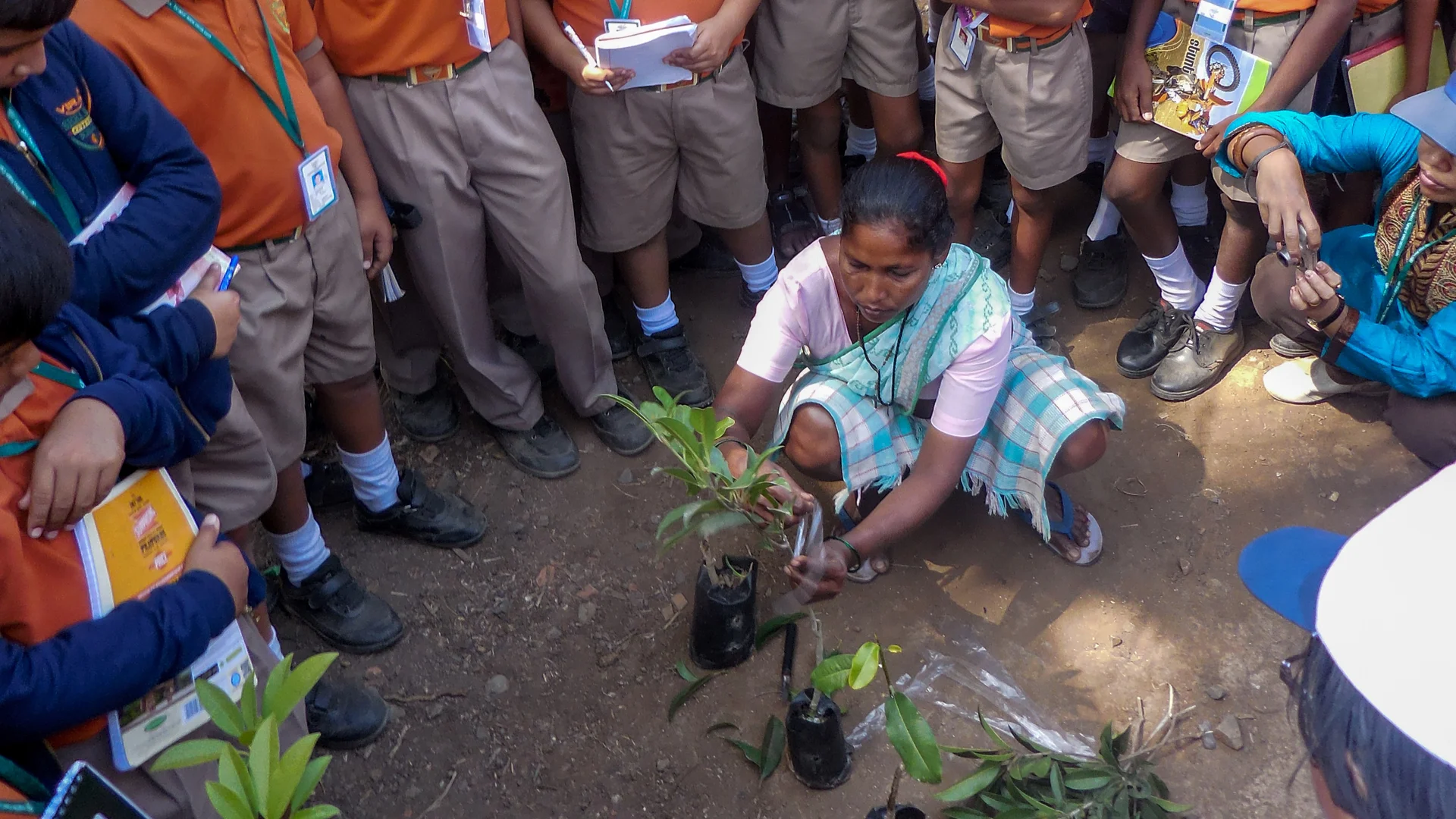
In Gholvad, a chikoo orchard is part of everyday work. A guided visit gives students a close look at nursery plants, composting, water use and the people who care for a farm. A chikoo grafting demonstration, like the one pictured on this page, is a useful starting point for questions about how fruit trees are grown.
The farm was showing farmers and college students how it works long before the term “agro-tourism” existed. Tell us whether your group is studying plants, food systems, water, local livelihoods or art, and we will suggest which parts of the farm and which hands-on sessions suit the students' ages, the season and the time available.
For colleges, overnight study camps can be arranged for smaller groups, within the farm's 11 rooms. Ask about a Warli dance or tarpa music performance for your students; it depends on the performers being available.
A guided walk through the working farm, told through questions. The answers are on the tour; what you see depends on the season and the farm’s work that day.
Look up at the canopy in the orchard, and ask the guide how the trees were brought down to size.
The bee boxes in the orchard have a job that matters more to the fruit than to the kitchen.
In the government-registered nursery, see how chikoo and mango plants are grafted and raised.
Crush, smell and compare aromatic leaves and grasses, from curry leaf to lemongrass and citronella.
Follow the rain past three check dams to the lined farm pond and back into the ground.
Compare fish raised in the orchard canals with those in tanks where the water temperature is controlled.
Group day visit
Bring your school, college, corporate team or community group to our working farm in Dahanu. Explore, learn and spend time together — we’ll plan an outing around your group.
Minimum group size: 25 guests
A Day at Save Farm is planned for groups of 25 guests or more and is quoted on enquiry.
If some of your group would like to stay the night, rooms are booked as couple or family packages. See overnight packages
A Day at Save Farm is planned for 25 guests or more, and the farm can host day groups of over 100. Send the student count, age range, teacher count and preferred date so we can propose a programme and quote.
Tell us what the students have covered in class and what you hope they will see: the nursery, composting, water harvesting, pollination or rural crafts. The farm walk depends on the season; we confirm the visit plan and meals before you commit.
The farm is 2.5 to 3.5 hours by road from Mumbai: take NH-48 north past Manor and turn towards Dahanu at Charoti (Kasa Naka). Cars and buses of up to 30–35 seats can park inside the farm.
There is no medical staff on the farm. A primary health centre in Gholvad is 5 to 10 minutes away and a hospital in Dahanu is 20 to 25 minutes away. Please bring enough teachers or supervisors for your group.
A Day at Save Farm starts at 25 guests, and the farm can host day groups of more than 100. Tell us your expected count so we can plan the programme and arrangements.
Yes. The nursery, composting, rainwater harvesting, pollination and rural crafts tie in well with science, geography, environmental studies and art. Share the age group and topics and we will suggest a plan.
Yes. Save Farm has hosted study tours in Botany, Rural Development and Environmental Studies for many years, including overnight study camps for smaller groups. Share the course, approximate count and dates.
The farm is a government-registered nursery, but a particular demonstration depends on the date and team availability. Ask for it when you enquire so we can confirm what is possible.
The farm has 11 rooms, so a large school group should plan around the group day visit. Overnight study camps can be arranged for smaller college groups; ask us about supervision and rooms.
There is parking inside the farm for cars and buses of up to 30–35 seats.
There is no medical staff on the farm. A primary health centre in Gholvad is 5 to 10 minutes away and a hospital in Dahanu is 20 to 25 minutes away.
Tell us the age group, student count, preferred date and learning interests.